
Single-Core or Twin-Core PV Cable: Choosing by Layout
Both forms are published in the same sizes, with 4 mm², 6 mm² and 10 mm² named as the commonly used specifications, so the choice between single-core and twin-core is settled by the route rather than by the copper. What changes is the number of clips, the number of pulling operations and how the pair behaves where it has to split.
Key takeaways
- Single-core and twin-core versions exist in the same published family, in the 4 mm², 6 mm² and 10 mm² sizes the site calls commonly used.
- A twin-core run needs one pulling operation and one drum position where two single cores need two of each.
- A single-core run can be separated at a combiner box without cutting a jacket, which a twin-core length cannot do without terminating it.
- Service life is published as 25 years or more, with 30 years given on one product page and 25 years tied to TUV-certified performance.
The route decides before the datasheet does
Conductor construction, insulation and sheath are the same material story in both forms, so the mechanical difference is what a designer is really choosing. A rail-mounted rooftop string runs both poles along the same line for tens of metres, and there the twin-core form is a natural fit: one jacket, one fixing point per metre, one item to handle. A run that leaves the roof, passes through a wall and lands in a combiner box is a different problem, because the two poles may need to arrive at different terminals or be separated before the gland. In that layout a single-core pair gives freedom that a bonded pair does not. The published solar pv cable range covers both, which means the decision is available at the specification stage rather than being forced by the catalogue.
Twin-core where the pair travels together
The case for a bonded pair is mostly about parts and labour. One cable means one drum position, one pull through the clips and one length to order per route; two single cores mean two of each, and twice the chance that one leg is short at the end of a run. Along a rail the clips sit where the rail sits, so a bonded pair takes one clip where two singles take two, which is a real reduction on a long roof. The trade-off is stiffness: the outer jacket of a twin-core length is larger than either single core, so the published bending rule of four times the outer diameter applies to the pair as a whole, and a corner that a 6 mm single core takes easily may need more room in twin-core form. On a route with many changes of direction, that difference in radius can outweigh the savings in clips.
Single-core where the pair has to split
Single cores come into their own at every point where the two poles go their separate ways. A combiner box receives each string on its own terminals, an inverter may be fed from two directions, and a maintenance swap sometimes involves one conductor rather than a pair. With separate cables, each leg can be pulled, dressed and terminated independently, and a spare coil of one size covers either polarity. The cost is counted twice: two lengths on the order, two pulls, and a fixing arrangement that keeps the two cables from crossing or chafing where they share a clip. The published weight table helps here, because a designer can see that a 6 mm² pair in single-core form adds 156 g/m to the structure while a twin-core 6 mm² puts the same metallic mass inside a single jacket (author's calculation: 78 g/m × 2 = 156 g/m from the published weight of one cable).
| Layout situation | Form that usually suits it | What changes on site |
|---|---|---|
| Rail-mounted rooftop string | Twin-core | One clip per fixing point, one pull |
| Long feeder to the inverter | Single-core | Each leg sized and pulled on its own |
| Landing in a combiner box | Single-core | Poles terminate separately without cutting a jacket |
| Module-level jumpers | Twin-core | Short bonded lengths, fewer loose ties |
| Ducted or buried route | Either, chosen on pulling length | Draw rope and bend radius set the limit |
Connectors and pre-made assemblies
The termination side is published as a range rather than as a single part: MC4 and other solar connectors, solar fuse connectors, solar diode connectors and pre-made PV cable assemblies all appear on the site. Whichever form is chosen, the end of the run has to be mated, and both forms need the same number of mated pairs per polarity. That is where assemblies earn their place, because a factory-made joint takes the field work out of the equation and leaves the installer with a connector to plug rather than a connector to crimp. The published data stops at the cable and names the parts; the assembly drawings, the crimp specification and the torque figures are the documents to request with the connectors, since the site does not publish them. The dimension table is the other document worth having in hand, because it gives the diameter that decides which gland fits.
What the service-life chart adds
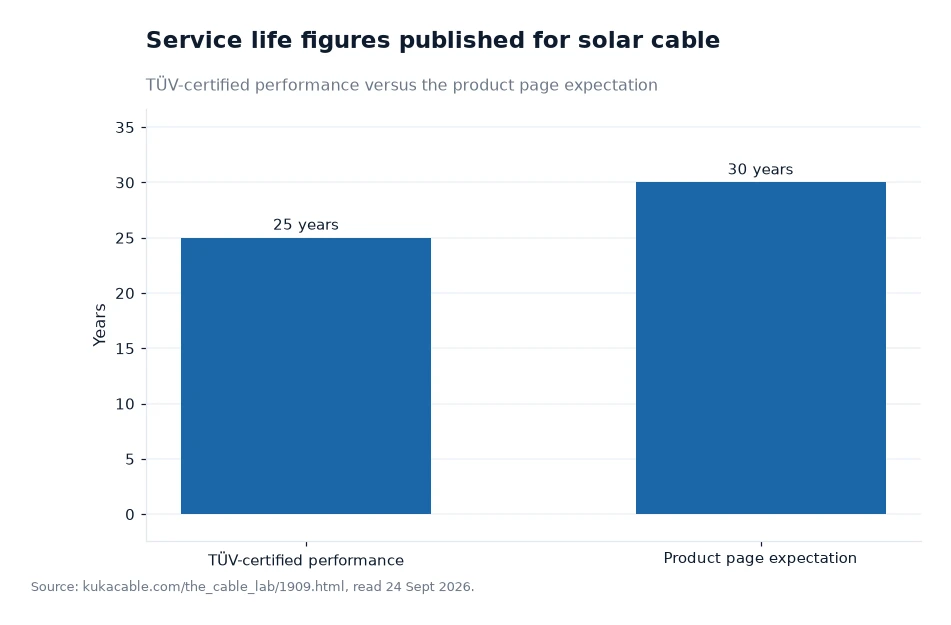
The chart carried with this article is about durability rather than layout. It shows two service-life figures that KUKA CABLE publishes for the same product family: 25 years tied to TUV-certified performance, and 30 years given on a product page as that model's expected life. The site also uses the phrase 25 years or more in its general description, so the two numbers should be read as a range rather than as a contradiction. For this decision the figures matter because a bonded pair and a separated pair are fixed differently; a cable held firmly at four times its diameter over a purpose-built support has a better chance of reaching the published horizon than one squeezed into a clip sized for a smaller cable. Site the clips to the form actually ordered, and the published life figure stops being a marketing line and becomes an installation requirement.
Worked example: clips over a hundred metres
Take a 100 m rooftop run with clips at 1.5 m centres. That spacing gives 67 fixing points along the route (author's calculation: 100 ÷ 1.5 = 66.7, rounded up). In twin-core form the whole run needs those 67 clips. In single-core form the two cables need a fixing at each point as well, and unless a double clip is used the count doubles to 134 clip positions (author's calculation: 67 × 2 = 134). The assumption is a spacing of 1.5 m chosen by the author, since the site publishes no spacing; what the site does publish is the mass per metre and the four-times-diameter bending rule that the clips have to respect. On a short run the difference is a handful of parts, and on a long roof it becomes a line item in the installation estimate.
Frequently asked questions
When is a twin-core cable the better choice?
It suits a layout where the two poles travel along the same route without separating, such as a rail-mounted rooftop string, because one jacket replaces two and each fixing point takes one cable. The published family offers twin-core versions in the same 4 mm², 6 mm² and 10 mm² sizes used for single cores.
Do the two forms carry different ratings?
The published construction is the same in both: tinned copper class 5 flexible conductor to IEC 60228, electron-beam cross-linked XLPO insulation and sheath in low-smoke halogen-free compound, a rated voltage of DC 1.8/1.8 kV, and an ambient range of −40 °C to +90 °C. The difference between the forms is geometry and handling, not the material specification.
How to write the layout into the enquiry
Describe the route rather than the product: say whether the pair stays together for its whole length, where it splits, and how many changes of direction it makes. Give the size and the form for each section, since a run can change form at a combiner box, and quote the published diameter of both so the glands and clips can be ordered together. Ask for the connector evidence separately and name the model family, H1Z2Z2-K, PV1-F or UL 4703 wire, so the data sheet returned matches the standard the project quotes. Check the published figures on the reply, weight per metre and bending radius, and confirm the test list behind the claim. The site publishes no price, minimum order or lead time, so those belong in the commercial thread.
Core-count choices and the 25-year against 30-year service wording are sourced from the manufacturer's own website, kukacable.com, collected 24 Sept 2026[1].