
Checklist: Writing a Commercial Lighting Brief
A useful commercial lighting brief tells suppliers what the fixture must do, where it will be installed, which design decisions are fixed, what evidence is required, and how alternates will be evaluated. It connects the room schedule to measurable performance, controls, finishes, documentation, packaging, delivery, and approvals. Clear inputs reduce the risk of comparing quotations built around different assumptions or discovering interface gaps after purchase.
Key takeaways
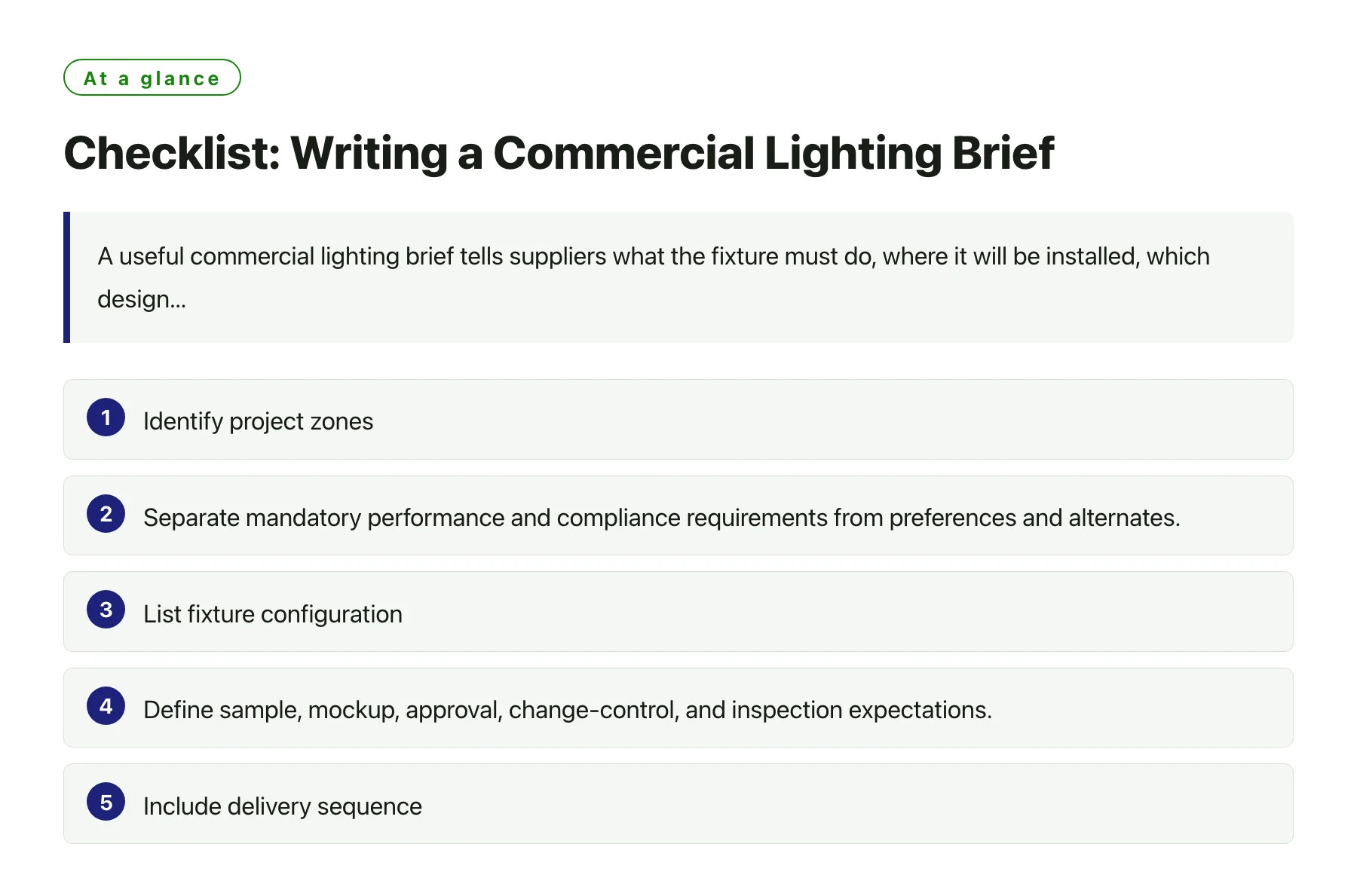
- Identify project zones, quantities, mounting conditions, and applicable design drawings.
- Separate mandatory performance and compliance requirements from preferences and alternates.
- List fixture configuration, controls, accessories, finishes, and required submittal documents.
- Define sample, mockup, approval, change-control, and inspection expectations.
- Include delivery sequence, spare parts, packaging, and responsibility for open decisions.
A brief should be specific enough to compare offers and flexible enough to show where a supplier proposal needs design review.
Project identity and operating context
Give the project name, site location, project phase, issue date, and brief revision. Identify the design lead, electrical engineer, procurement contact, contractor, and person authorized to approve substitutions. Provide relevant reflected ceiling plans, elevations, interior finish references, and room schedules. State whether the supplier is pricing a complete fixture, a component, or a coordinated package.
Describe the building type and spaces in scope: guest rooms, public areas, corridors, meeting rooms, restaurants, service areas, exterior zones, or other locations. Include operating hours, maintenance access, exposure conditions, and any special scene or event use that affects selection. Different spaces may use similar fixtures but have different control, glare, finish, or service expectations.
Name the drawing and specification revisions suppliers should use. State how questions and addenda will be issued so all bidders receive the same clarification. Identify any unconfirmed site dimensions or electrical information and the date by which it is expected. This makes assumptions visible and gives procurement a basis to compare proposals fairly.
Fixture schedule and configuration
For each fixture type, provide a unique tag, room or zone, quantity, mounting type, nominal dimensions, finish, trim, lens or diffuser, source or LED module, driver, voltage, and required accessories. Identify variants as separate lines when optics, output, control, color, mounting, or finish changes. State the manufacturer and model where the design is prescriptive; if alternatives are permitted, describe the equivalency process.
Clarify whether the proposal includes lamps or modules, drivers, canopies, suspension kits, brackets, trims, sensors, emergency components, control gear, and spare parts. Note any building-supplied or contractor-supplied components. A complete list prevents a low initial quotation from omitting items required to make the product operable or installable.
Buyers evaluating lighting suppliers for hospitality projects can share one version-controlled schedule with every candidate. Ask suppliers to identify each deviation in a marked-up response and not silently substitute a visually similar product. The project designer can then assess effects on appearance, performance, integration, cost, and schedule.
Performance and visual requirements
State the project’s requested light output, distribution, color characteristics, glare control, beam shape, and operating scenes where these values have been set by the lighting designer. Identify the calculation or submittal method and who will review it. If a value remains a design decision, flag it as open and ask suppliers to list their proposal separately from compliant pricing. Avoid mixing an unapproved preference with a mandatory criterion.
Describe relevant viewing conditions and adjacent surfaces. For decorative or feature fixtures, specify the visible proportions, finish references, and acceptable sample variations. For functional fixtures, state where uniformity, task visibility, vertical illumination, or other performance objectives matter. The brief should communicate the design intent without trying to replace the project professional’s lighting calculations or local code review.
Request photometric documentation for the exact offered configuration. The Illuminating Engineering Society lists ANSI/IES LM-63 as a standard electronic transfer format for photometric data. Ask for the file and associated product information, then have the designated lighting designer confirm that it matches the model, optics, and version proposed for the project. [1]
Controls and electrical coordination
List supply voltage, frequency, driver type, dimming method, control protocol, addressability, sensor requirements, and any interface with the building-management or room-control system. Identify who is responsible for compatibility testing and commissioning. If the control scheme is not finalized, specify the decision deadline and request priced options without representing them as approved.
Describe the functional behavior expected from the system: dimming range, scene recall, switching zones, occupancy response, daylight response, or integration with guest-room controls where relevant. Avoid specifying performance that has not been coordinated with the engineer. Request wiring diagrams, terminal details, and driver data for review before procurement.
Identify any required electrical, safety, environmental, or market documents and who will validate them. The brief should state the destination market and intended installation, but the qualified project compliance owner must determine applicable rules. Ask suppliers to tie their documents to the exact fixture model and driver rather than submitting unrelated product-family files.
Samples, mockups, and approvals
Define which fixtures require a physical sample, finish sample, functional test, or installed mockup. State the project location, representative room conditions, required surrounding finishes, control settings, reviewers, and decision date. A mockup is most useful when the room context can change the assessment of glare, reflections, color, scale, or installation access. Bench samples answer a narrower set of questions.
Set an approval record format. It should identify fixture tag, supplier, model and revision, optics, driver, finish, accessories, sample date, reviewer, accepted attributes, open items, and conditions. Name the person who can approve technical, design, and commercial aspects. If approval covers finish only or construction only, write that limitation explicitly.
Allow time for corrections and resubmission in the schedule. State what happens when a sample is rejected, when a supplier proposes an alternate, or when a requested document is incomplete. Do not treat a missed comment deadline as approval unless the contract expressly provides for that result and the project owner has accepted the process.
Submittals, quality, and change control
List submittals required with the quotation, before approval, before production, and before shipment. Depending on the project these may include dimensioned drawings, photometric files, electrical data, finish chips, test documents, installation instructions, maintenance information, packing details, warranty terms, and spare-part references. Identify the file format and reviewer for each item.
Describe how approved revisions will be controlled. Require written notice and review for changes to model, LED source, driver, optics, finish, factory, components, or manufacturing process if the change can affect an accepted requirement. Suppliers should identify deviations in a change log and wait for the named approver before proceeding with affected production.
State the quality checks and records expected for the order: model and tag verification, appearance, operation, accessories, labels, carton condition, and any agreed sampling or inspection. Define who witnesses checks, what constitutes a nonconformity, how corrective action is recorded, and who authorizes release. Be explicit that inspection scope and sampling determine what a report can support.
Commercial, logistics, and handover details
Give the bid currency, requested quantities, delivery point, price validity, payment assumptions, lead-time basis, and separately priced tooling or samples. Ask suppliers to show unit price, accessories, packaging, spares, inspection, and freight-related exclusions clearly. Identify whether the quotation covers one shipment or phased releases and how changes in room count affect pricing.
Provide the required delivery sequence by building, floor, room type, or installation phase. State carton labeling, packing-list, pallet, storage, and handling requirements. Include the receiving contact and any site access or booking conditions that could affect delivery. Ask suppliers to identify the assumptions behind their production and transit estimates.
Request the recommended spare components and product-identification information needed for facilities management. Confirm how drivers, modules, lenses, and decorative parts can be ordered later and whether part numbers will remain traceable. Include instructions, maintenance data, warranty contacts, and commissioning support expectations in the closeout package where they apply.
Issue a controlled bid package and compare responses
Before issue, check that the brief, schedule, drawings, finish references, and submission form use the same fixture tags and revisions. Remove contradictory notes, label superseded documents, and identify the question deadline and submission date. Keep a response register so the design team can see what each supplier included, excluded, or left unanswered.
Compare offers using a compliance matrix. For each requirement, record the supplier response, evidence, deviation, reviewer, and disposition. Separate compliant offers from alternates and unresolved assumptions. A weighted score can assist a decision, but a strong commercial score should not erase a missing mandatory performance or safety requirement.
After selection, attach the final approved schedule and documentation to the purchase order. Keep sample approvals, photometric files, electrical data, change approvals, packing instructions, and delivery sequence in one controlled record. This makes the brief useful beyond tendering and reduces the chance that intent is lost between design, procurement, factory production, and installation.
Sources
Frequently asked questions
What is the most important item in a commercial lighting brief?
A consistent fixture schedule linked to room context, approved configuration, required evidence, controls, and named reviewers gives suppliers a comparable basis to respond.
Should suppliers be allowed to propose alternates?
Yes, when the brief defines the equivalency evidence and review path. Require deviations to be listed separately so an alternate is not mistaken for the specified product.
What documents should accompany a luminaire quotation?
Request the documents needed to evaluate the exact offer, such as drawings, photometric data, electrical and control details, finish information, required compliance evidence, lead time, and exclusions.
How does a mockup differ from a product sample?
A sample helps review the fixture itself. A mockup adds the room, mounting, adjacent finishes, viewpoints, and controls that can affect the design decision.
© Sevilla Report · Founded in Seville, 2016